
Squash ghosting and badminton footwork drills with reaction lights
Updated 7 November 2026 · 3 min read
Place a light in each corner you want to train, six for squash ghosting or badminton footwork, and have the player move from the base (the T in squash, the centre in badminton) to whichever light comes on, touch or wave a racket over it, and return. Work in sets of 30 to 60 seconds and use the time to each corner to find the slow one.
Ghosting, moving to the corners without a ball, is the backbone of court movement in squash and badminton. The weakness of a set pattern is that the player knows where to go next. Lights make the corner unpredictable, so the player has to read, push off and recover, just like in a rally, and they show exactly which corner costs time.
See every Squash drill running ›
Setting up the court
- Squash: six pods, at the front two corners, the two side walls at the T line and the two back corners. The base is the T.
- Badminton: six pods, at the front left and right, the two sides at mid-court and the two rear corners. The base is the centre of the court.
Pods can sit on the floor, on a cone, or low on the side walls. Use the wave answer so the player can sweep the racket over the pod, which is closer to a real stroke and keeps the phones safe.
Drills to run
- Six-point ghosting (60 s). Random corners, back to the base after each. The standard drill.
- Return to the T. A centre pod lights after every corner, so the recovery step is timed too.
- Front-court pressure. Only the front two and the side pods: short, sharp lunges.
- Back-court pressure. Only the rear and side pods, for the long movement and recovery from the back.
- Split step and first step. One light, two options. Split step as the opponent would hit, read the light, take the first step. Short sets of 6 to 10 lights.
- Go / no-go ghosting. Green corners are real, red ones are dummies to hold on. Trains balance at the base.
Coaching cues
- Split step as the light is about to appear, not after.
- Lunge with the racket leg forward; the last step is the longest.
- Push back to the base before the next light, not only when it appears.
- Keep the racket up and the head still; speed without balance only looks fast.
Finding the weak corner
After each set, look at the time to each pod rather than only the total. Most players have one or two slow corners, often the back corner on the backhand side. The result screen shows the slower side directly. Spend the next block on that corner and check whether the gap closes over a few weeks.
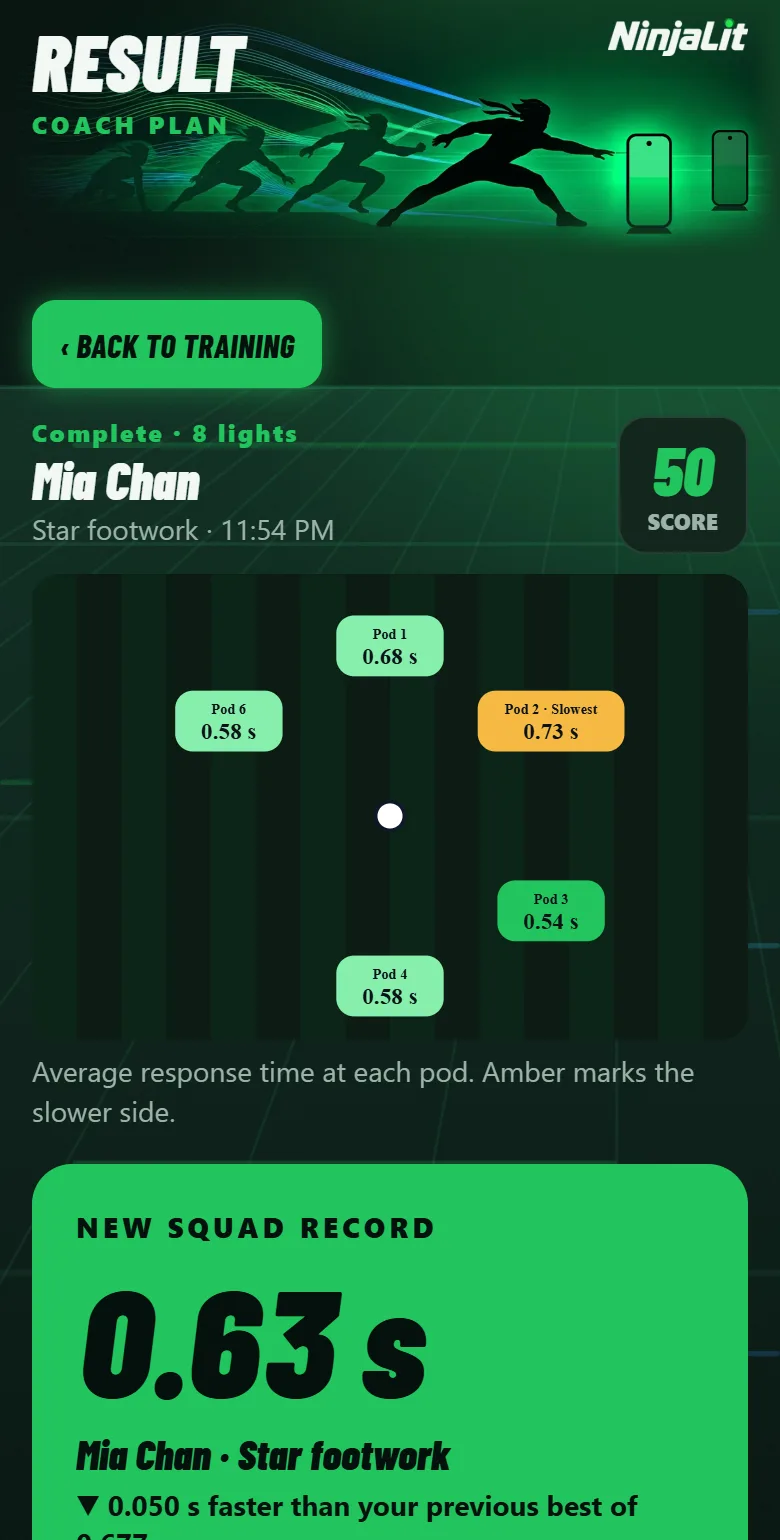
A ghosting session
| Block | Drill | Work / rest |
|---|---|---|
| Warm-up | Shadow movement at half pace | 5 min |
| 1 | Split step and first step | 4 × 8 lights / 45 s rest |
| 2 | Six-point ghosting | 4 × 45 s / 90 s rest |
| 3 | Weak-corner block | 3 × 30 s / 60 s rest |
| Finish | Go / no-go ghosting | 2 × 45 s |
Common questions
How many lights do I need for ghosting?
Six for full-court ghosting. Four already make a good front-and-back drill, and two are enough for split step and first step.
Can the player use the racket instead of touching the light?
Yes. With the wave answer, the pod's camera notices a hand or racket passing over it, so the player can sweep the racket without stopping to touch a screen.
How long should a ghosting set be?
Thirty to sixty seconds for movement quality, with at least as long to rest. Longer sets turn into fitness work, which is useful too, but separate.