
Football reaction drills: footwork, goalkeeper and defender drills with lights
Updated 7 November 2026 · 3 min read
The most useful football reaction drills are quick-feet patterns to lights placed around the player, goalkeeper dives to the lit side, go / no-go defender reads and change-of-direction cuts. Use two to six lights, sets of 20 to 40 seconds and full rest, and compare each player only with their own times.
Football is full of reactions: a ball deflects, an attacker shifts their weight, a keeper reads a shot. Cones teach patterns; lights add the unexpected cue. These drills work for youth teams and adults, need only a small area and a few phones as lights, and give every player a number to improve.
Star footwork (quick feet)
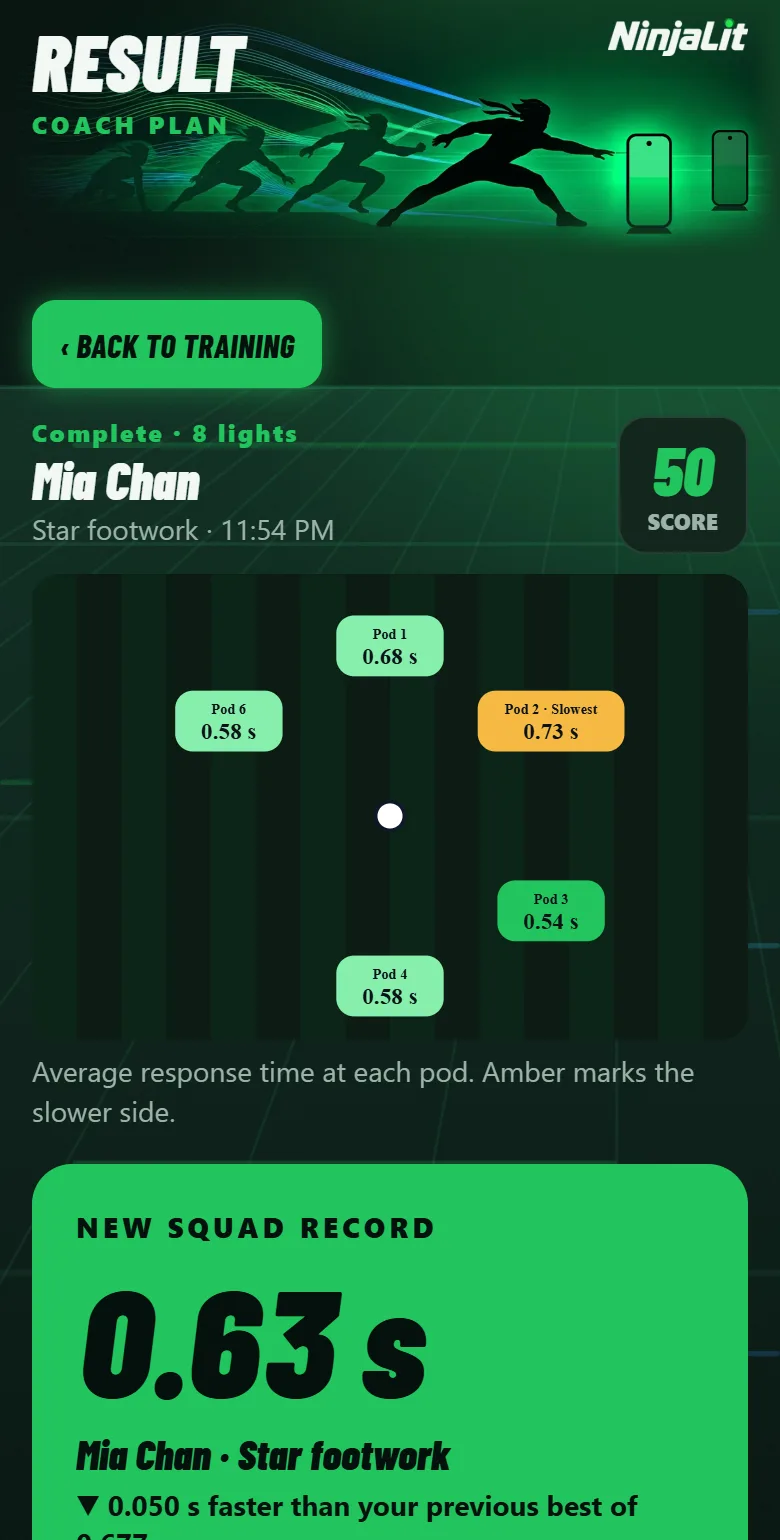
Place five pods in a star around the player, about one to two metres away. A pod lights at random; the player steps to it, touches it and comes back to the middle. Work for 20 to 30 seconds. Coaching points: stay on the balls of the feet, short steps, chest up so the eyes can find the next light.
Goalkeeper reactions
Put one pod low on each side of the goal, or two on each side at different heights. The keeper starts in the ready position; when a pod lights, they dive or step to that side and touch it. Use the wave answer so the keeper can slap past the pod instead of landing on a phone. Record the time for each side: most keepers have a slower side, and the result shows it.
Defender read (go / no-go)
Two pods to the left and right of the defender. Green means step and close down that side; red means stay balanced and do not bite. This trains the patience not to commit on a feint as much as the speed to react to a real move. Count both the time and the mistakes.
Agility T-test with lights
Set pods in a T: one at the start, one about ten metres ahead, and one five metres either side of it. Sprint forward, shuffle to the side that lights, shuffle across, and back-pedal to the start. The time to each pod shows where the time is lost: the sprint, the shuffle or the turn.
Arrow cuts
Sprint towards a pod; as you approach, it shows an arrow left or right and you cut that way. This is closest to reacting to an opponent mid-run. Only use it once players can stop and turn safely, and on a surface with good grip.
Session plan
| Block | Drill | Work / rest |
|---|---|---|
| Warm-up | Jog, skips, side steps, light chase at half pace | 5 min |
| 1 | Star footwork | 3 × 20 s / 60 s rest |
| 2 | Defender read | 3 × 30 s / 60 s rest |
| 3 | Agility T-test | 3 runs, full rest |
| Keepers | Goalkeeper reactions | 4 × 6 lights |
Put the block early in the session, while legs are fresh, and finish with the normal game work.
Common questions
How far apart should the lights be?
For quick feet, one to two metres. For goalkeeper and defender drills, use the real distances of the position. Keep the layout the same from week to week so times can be compared.
Can I use reaction lights outdoors?
Yes, but phone screens are harder to see in bright sun. Shade the pods, turn brightness to maximum or train in the evening or indoors.
How many players can train at once?
One player per set of pods, with others resting or doing a skill station. With more pods you can run two stations, or a race where two players chase their own colour.