
Reaction light training: what it is, what it trains and how to start
Updated 9 November 2026 · 6 min read
Reaction light training uses lights that switch on unpredictably; the athlete moves to each light and touches it as fast as possible while the time is recorded. It practises reacting to a signal, moving quickly to it and, with go / no-go colours, deciding whether to move at all. Short sets of 20 to 60 seconds with full rest work best.
Most conditioning drills are pre-planned: the athlete knows exactly where to run next. Sport is not like that. Reaction light training adds the missing piece, a signal the athlete has to see and answer, and it gives a number for every attempt so progress is visible.
How it works
A set of lights, or pods, is placed around the athlete. A controller decides which pod lights and when. The athlete gets to the lit pod and touches it, or waves over it, and the pod records the time from light to response. A drill is a sequence of these: a fixed number of lights, or as many as possible in a set time.
Because the order and timing are random, the athlete cannot rely on memory. They have to watch, decide and move, which is the point.
The main drill types
| Drill type | How it runs | What it works on |
|---|---|---|
| Random | One pod lights at a time; get to every light | Reaction and first-step speed |
| Go / no-go | Green means go, red means stay still | Decision making and control |
| Timed challenge | As many lights as possible in a set time | Speed under fatigue |
| Return to centre | Back to a centre pod after every light | Court movement and recovery steps |
| Focus | Find the green light among decoys | Visual search and attention |
| Sprint timing | Pod to pod along a route, with split times | Acceleration and route running |
| Sequence memory | Watch the order, then repeat it | Working memory and concentration |
| Arrow cut | Sprint at a pod, cut the way its arrow points | Change of direction |
| Colour challenge | Two to four players, each with a colour | Competition and reading the cue |
Who uses it
- Court and racket sports: squash, badminton, tennis and table tennis use it for footwork to the corners and the first step after a split step.
- Team sports: football, basketball, hockey and handball use it for defensive slides, goalkeeper reactions and cutting.
- Combat sports: strike the lit pad, hold back on the wrong colour.
- PE and youth training: it turns running into a game, and children ask to go again to beat their time.
- Older adults and rehabilitation: slower, gentle reaching and stepping drills with longer light cues.
How to structure a session
Reaction is best trained fresh. Put light drills after the warm-up and before hard conditioning, not at the end of a tiring session.
- Warm up with easy movement through the same patterns the drill uses.
- Work in short sets: 10 to 20 lights, or 20 to 60 seconds.
- Rest fully between sets, at least as long as the set, so each attempt is fast. In groups, rotating athletes gives natural rest.
- Stop before quality drops. When times rise and footwork gets sloppy, you are training fatigue, not reactions.
Measuring progress honestly
The number is the motivating part, so make it mean something. Compare an athlete only with themselves, on the same drill, the same layout, the same number of pods and the same way of answering. Changing the distance between pods or switching from touch to wave changes the times more than any week of training.
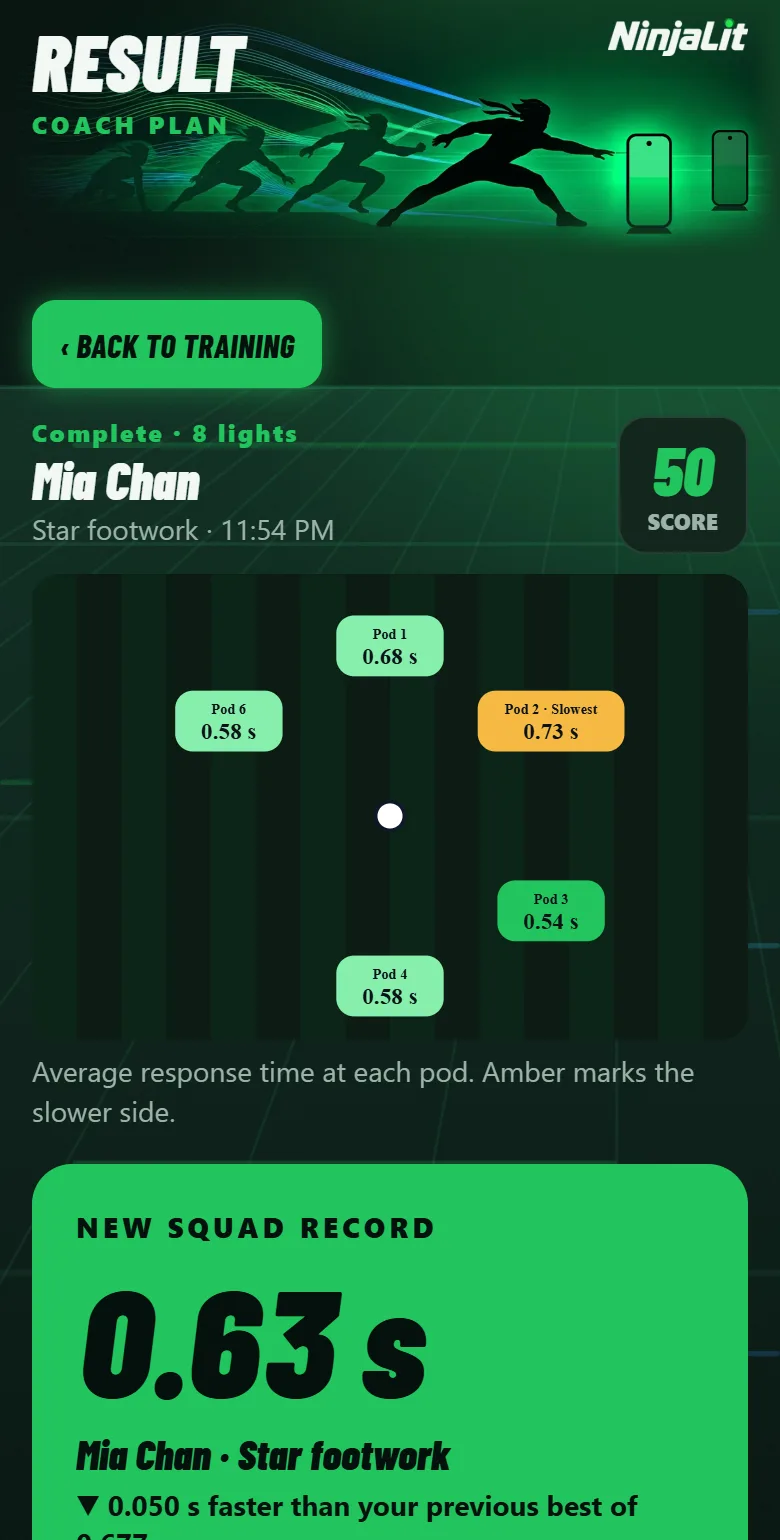
Look at more than the average. The time to each pod shows which side or corner is slower, and the miss count shows whether speed is coming at the cost of accuracy. Personal bests are fun, but a trend over several weeks says more.
A useful extra measure is decision time: run the same route once in a known order and once following random lights. The difference between the two is the time spent reading the signal and choosing where to go, and it is the part that light training works on.
What the research says
Sports scientists define agility as a rapid whole-body movement with a change of speed or direction in response to a stimulus (Sheppard and Young, 2006). Running a course you already know is change-of-direction speed; reacting to a signal you could not predict is agility. Light training sits on the agility side.
That difference matters. In a study of 38 Australian football players, a reactive agility test separated higher-level from lower-level players, while a 10 m sprint and a pre-planned change-of-direction test did not (Sheppard and colleagues, 2006). Reading the play and deciding where to go is part of what makes better players better.
A 2026 review pooled 28 randomised controlled trials with 755 team-sport players aged about 10 to 35 (Zhao, Liu and Xu, 2026). Its main findings:
- Reactive agility improved most: a large improvement on reactive agility tests, and a moderate one on pre-planned agility tests.
- Reaction-time tests on their own did not change significantly. Training seems to improve reacting and moving together, not a bare reflex.
- Young and high-level players gained most: the effects were largest in junior (11 to 14) and national-level athletes.
- The programmes that worked most often ran 7 to 8 weeks, more than three times a week, with sessions of 20 to 25 minutes. The authors rate the certainty of this evidence as moderate to low.
- Lights and people both have a place: visual signals such as lights give controlled agility gains, while a partner's or opponent's movement is more sport-specific.
Smaller trials of light-based training point the same way. Young basketball players improved a reactive agility test by 11% and their dribbling by 19%, ahead of a control group (Hassan and colleagues, 2022), and racing drivers improved their reactive agility and reaction time over a 6-week programme (Horváth and colleagues, 2022). These studies are small and each covers one sport, so treat them as encouraging rather than final.
In practice: use lights for short, regular, measurable blocks, judge each athlete against their own trend, and mix in cues from a partner or coach for game-like decisions.
Sources
Sheppard JM, Young WB. Agility literature review: classifications, training and testing. Journal of Sports Sciences 2006;24(9):919–932. doi:10.1080/02640410500457109
Sheppard JM, Young WB, Doyle TL, Sheppard TA, Newton RU. An evaluation of a new test of reactive agility and its relationship to sprint speed and change of direction speed. Journal of Science and Medicine in Sport 2006;9(4):342–349. doi:10.1016/j.jsams.2006.05.019
Zhao Z, Liu Y, Xu K. Optimizing agility training in team sport players: the role of perception-action coupling. A systematic review with multi-level meta-analysis. Journal of Sports Science and Medicine 2026;25:84–111. doi:10.52082/jssm.2026.84
Hassan AK, Alhumaid MM, Hamad BE. Reactive agility exercises with a light training system and the visual reaction time and dribbling of basketball players. Sports 2022;10(11):176. doi:10.3390/sports10110176
Horváth D, Négyesi J, Győri T, et al. A reactive agility training program using light-based stimuli for car racing drivers: a randomized controlled trial. Sports Medicine – Open 2022;8:113. doi:10.1186/s40798-022-00509-9
Common questions
How often should you do reaction light training?
Two or three short blocks a week, added to normal training, are plenty for most athletes. In the research, programmes of 7 to 8 weeks with sessions of 20 to 25 minutes most often worked well. Quality matters more than volume.
Is there research behind reaction light training?
Yes. A 2026 review of 28 randomised controlled trials found that agility training with signals to react to gave a large improvement in reactive agility, the kind used in games, while reaction-time tests on their own did not change significantly. Studies of light-based training specifically are smaller but point the same way.
Does reaction training make you faster in games?
It trains reacting to a visual signal and moving to it, which is part of most sports, and reactive agility is what separated higher-level players from lower-level ones in research. How much carries over depends on how closely the drill matches the movements and decisions of your sport, so choose drills built for it and mix in cues from a partner or coach.
Is it suitable for children?
Yes. Children usually love the game element. Keep sets short, the floor clear and the focus on fun and good movement rather than records.